Case studyRecruitment3 days
Dealls: Job Recommendation Algorithm
An assessment of Dealls’ job recommendation algorithm, with improvements to raise the average number of applications per job-seeker.
- Key skills
- User & Market Research
- User Research
- Competitive Analysis
- Product Research
- Tools
 Google Docs
 Google Sheets
- Google Forms

How much time do you have?
Dealls Job Recommendation Assessment and Suggestions for Improvements
Dealls is an online portal that facilitates the job searching, application, and screening process. It offers a wide range of job listings across various industries and roles from more than 3,500 companies across Indonesia. Dealls features a special job recommendation system called “Hanya Untuk Kamu”, designed to help job-seekers find relevant opportunities quickly and easily. This case study focuses on how to improve the experiences of existing job recommendation system and the accessibility of the job preference settings.
Since I do not have direct information regarding Dealls’ user behavior and preferences, I conducted simple user research in the form of a survey of 20 job-seekers aged 20–29 with prior experience using job portals. Throughout this case study, I will use data collected from the survey to validate my reasoning about the improvements needed in Dealls’ job recommendation system.
A. Rating the Job Recommendation System
The current recommendation system in “Hanya Untuk Kamu” demonstrates several commendable features, such as:
- Alignment with User Preferences & Experiences: The system not only considers the job-seeker’s selected job preferences, but also takes into account past work experiences when providing recommendations. This increases the likelihood that users will apply for jobs similar to those they have done in the past.
- Comprehensive Job Details: Listings include critical information like required experience levels, job types (e.g., full-time, internship, freelance), work models (remote, onsite, hybrid), location, salary, and facilities, which help users make informed decisions.
- Recruiter Activity Insights: Displaying when the recruiter was last active adds value, instilling confidence in users that their applications will be acknowledged promptly. This is great since it reassures job-seekers that the company is actively hiring for the role.
- Highlighted Listings: Descriptive tags like “loker butuh cepat” or “pelamar masih sedikit” cater to job-seekers with specific needs, such as urgency or low competition, enhancing usability of the job recommendation system and prompting job application.
Although the current job recommendation itself has done a great job in concisely displaying relevant information regarding the job roles, there are still some aspects regarding the algorithm that needs some fixing on.
- Irrelevant Job Recommendations: While the algorithm considers past roles, it does not adequately prioritize roles aligned with the user’s stated preferences or past experiences. For instance, as someone with prior experience as a product manager and prefers “Digital Product Manager” roles, the user would expect product management-related roles to dominate the top results. However, as we can see in image A.1., the algorithm recommends unrelated roles in fields like Business and Sales & Operations, which are roles not looked for by the user. Users could miss roles that are actually a perfect fit for them, but get distracted by irrelevant ones instead.
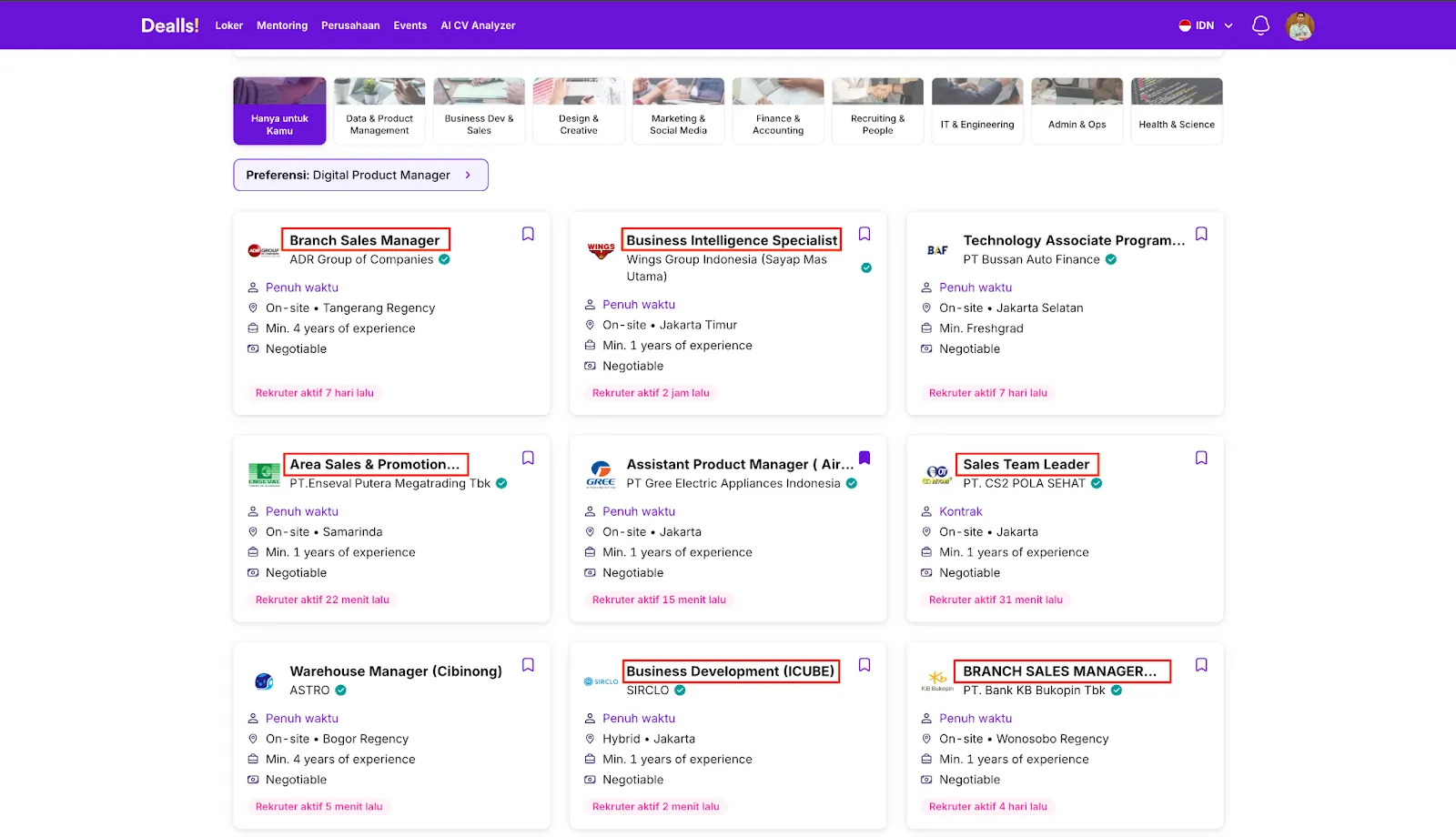
Image A.1. “Hanya Untuk Kamu” view for an ex-Product Manager (without setting any job filters)
- Job Prioritization Issue: The system’s prioritization logic is unclear, leaving users uncertain whether job preferences or past roles are given precedence. This ambiguity diminishes user trust and satisfaction with the recommendations. For instance in image A.2., someone with previous experience as a product manager and prefers to be an Android developer would get a seemingly random recommendation. The system recommends two product manager roles, and then two Android developer roles, then followed by the rest of product manager roles. This inconsistency in prioritization will confuse the user regarding the jobs that are being recommended, which should suit them the best.
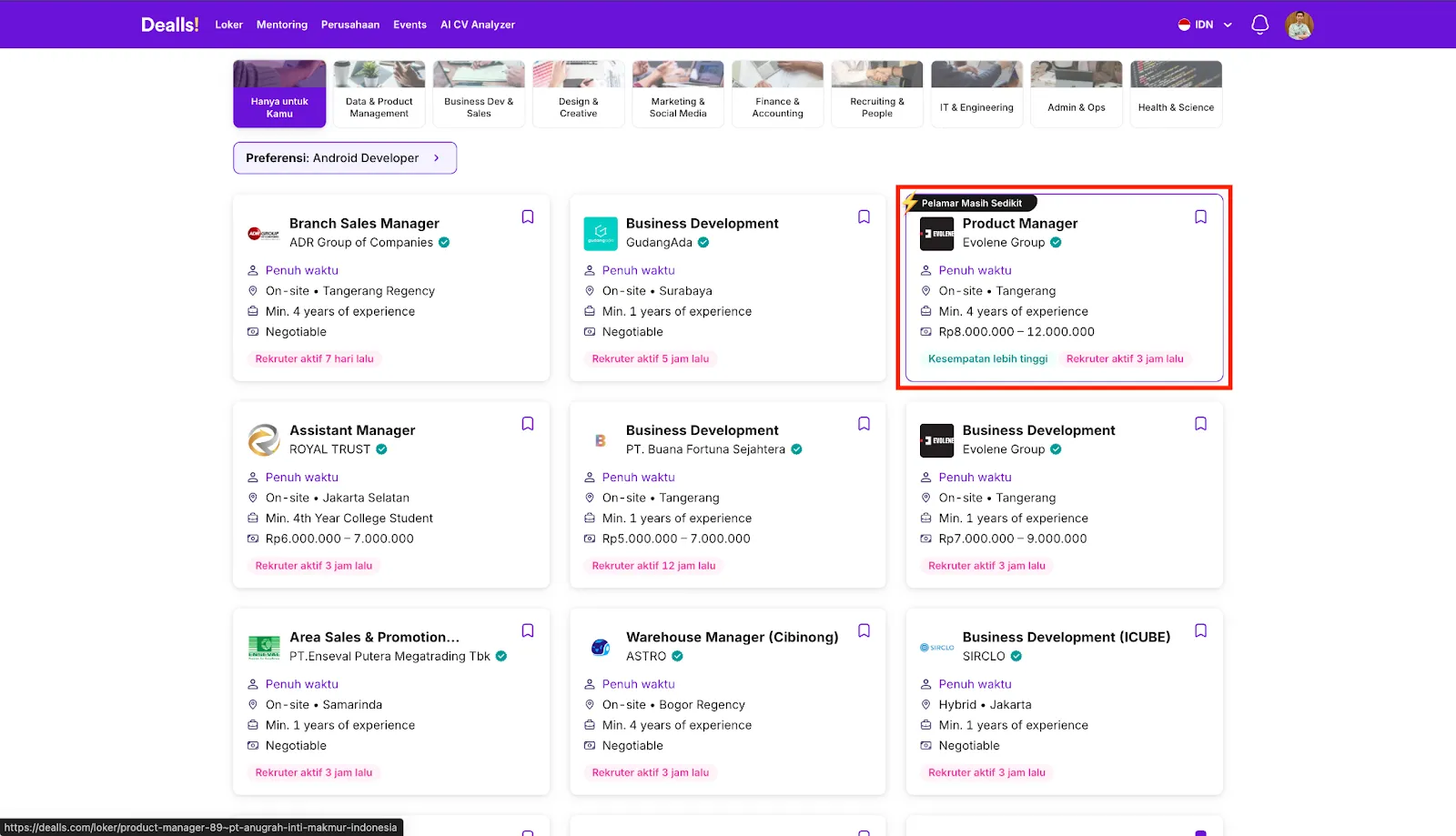
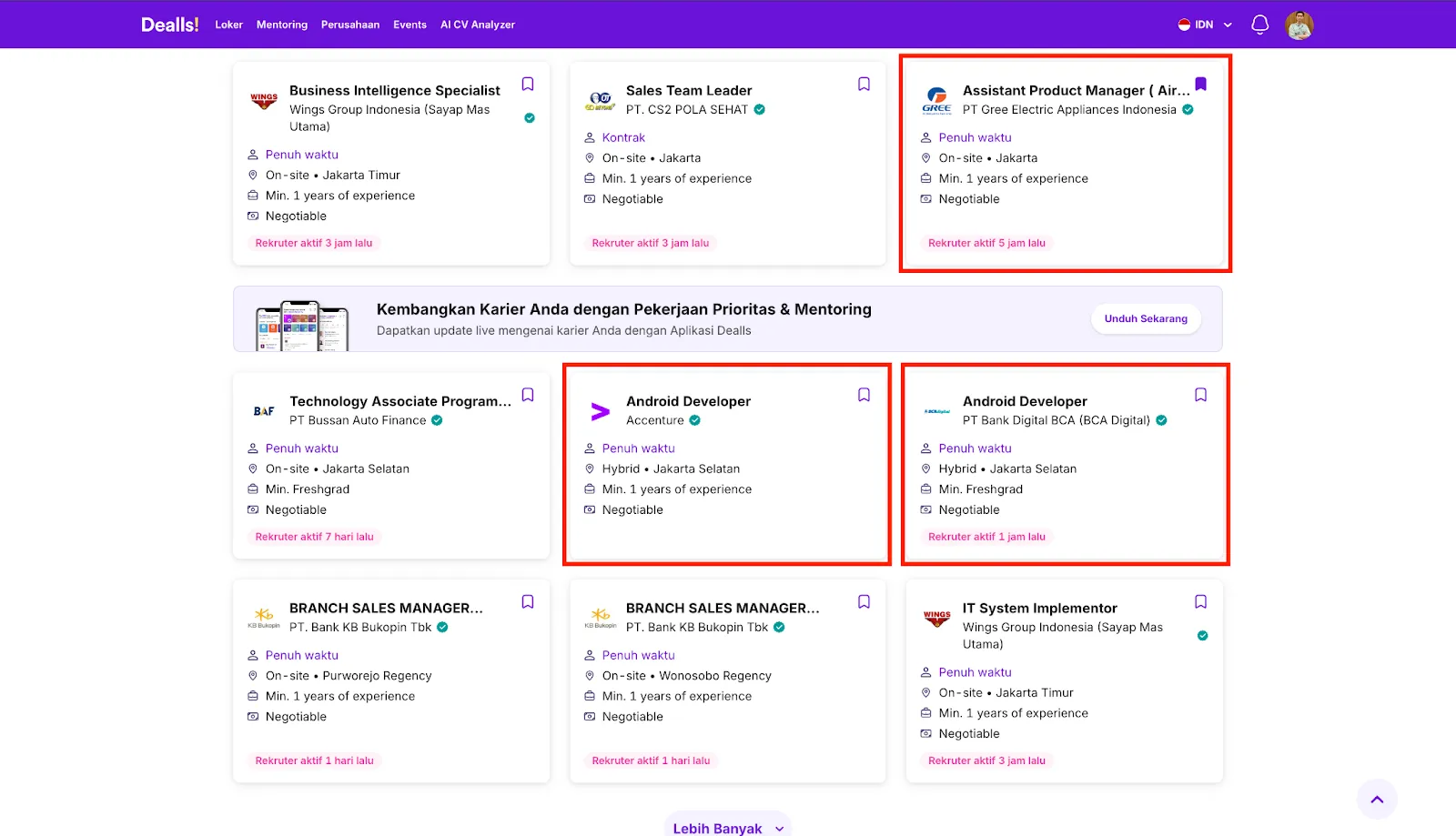
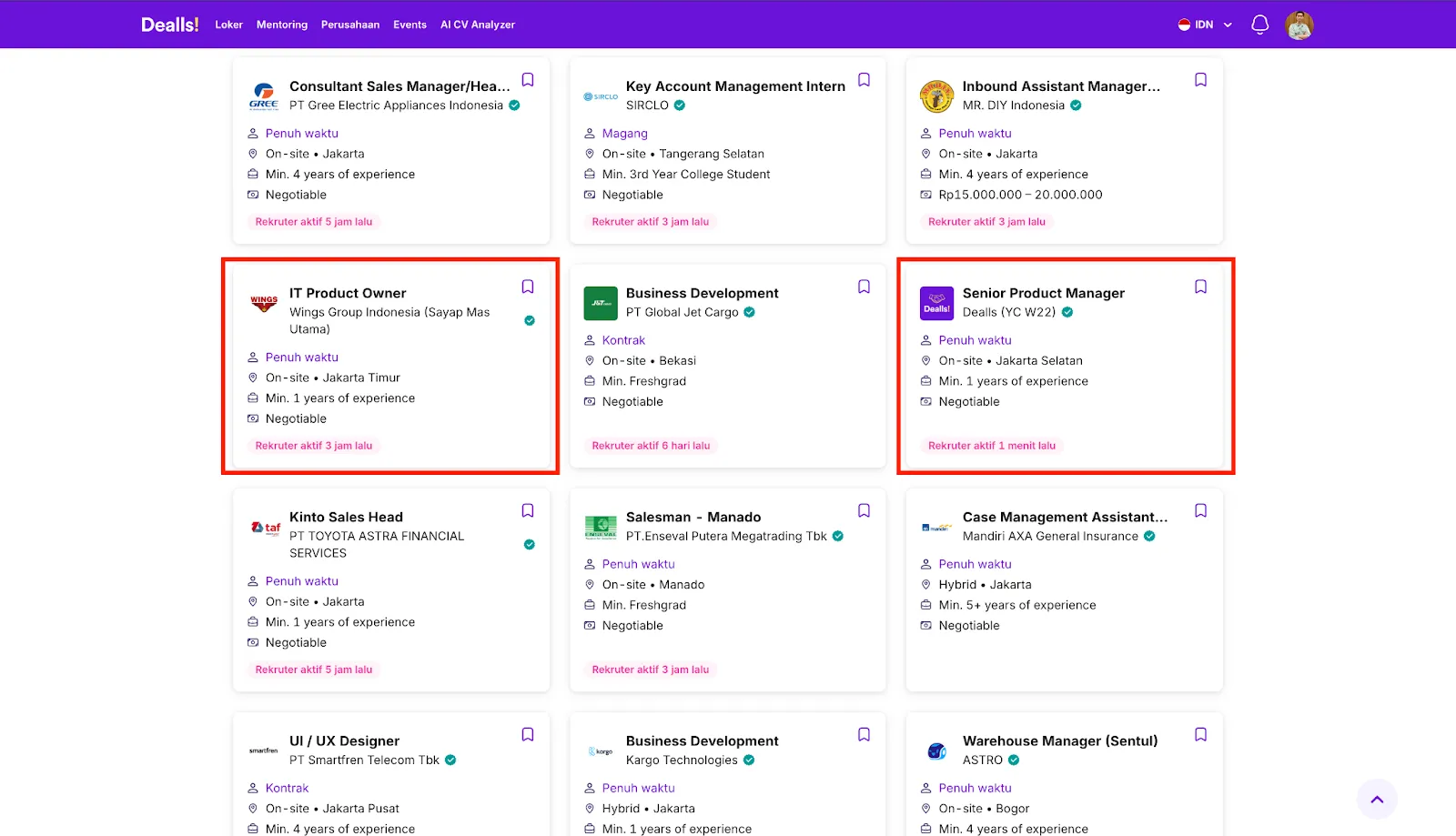
Image A.2. “Hanya Untuk Kamu” scroll view for an ex-Product Manager who preferred Android Developer Roles (without setting any job filters)
- Lack of Skill-based Job Recommendations: Job-seekers cannot easily assess whether their skills align with a job opening due to the absence of skill-related keywords in the recommendation interface. There is actually already a section dedicated for the user to mention their skills with “Keterampilan Keahlian” in the user’s profile section. Users would benefit from tailored suggestions based on their specific skills, increasing their chances of finding suitable roles.
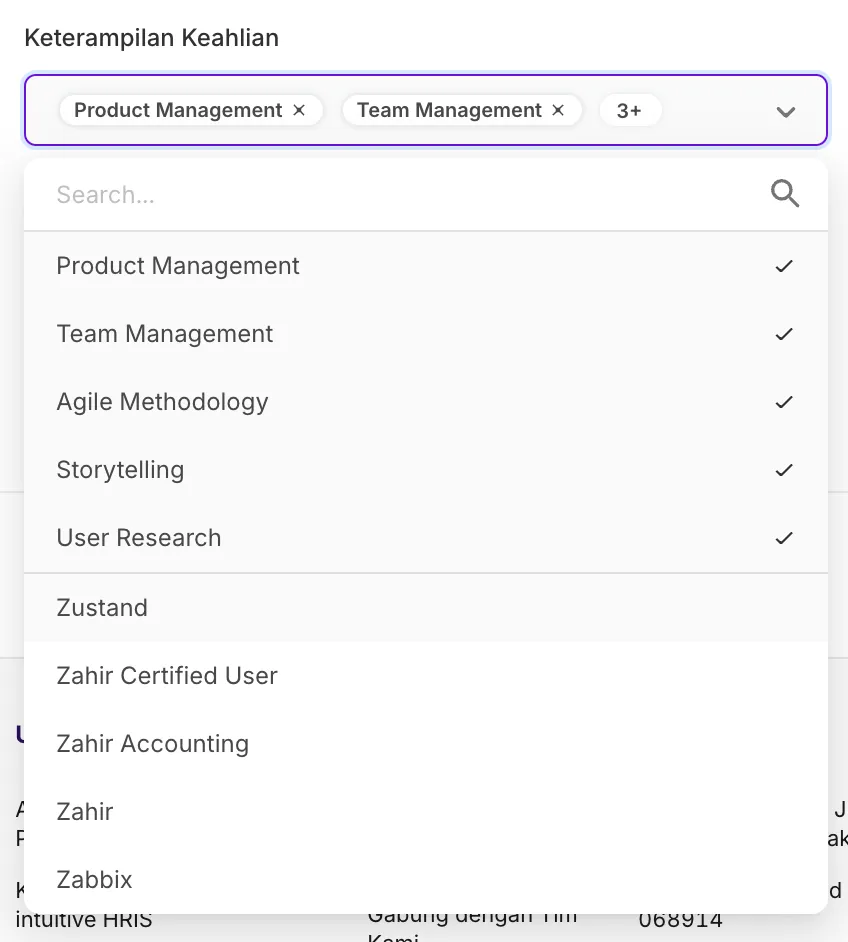
Image A.3. “Keterampilan Keahlian” settings in user’s profile
Given the current state of the algorithm in the “Hanya Untuk Kamu” section, I believe that 7 out of 10 is a reasonable score for the experience it has given. While the system effectively provides detailed job information, it falls short in delivering prioritized, relevant, and skill-based recommendations. These shortcomings hinder Dealls’ primary business objective of increasing the number of applications per job-seeker.
B. Job Recommendation System for Improvement
Since the algorithm in the “Hanya Untuk Kamu” section is still lacking in some areas, such as irrelevant job recommendations, lack of skill-based job recommendations, and job prioritization issue, here are some suggestions that I believe would improve the number of applications per job-seeker significantly.
-
Job Title Relation Algorithm Training: Irrelevant job recommendations stem from the inaccuracy of the keyword matching system. The current algorithm needs refinement to understand relationships between job titles. For example, for a product manager title, it actually falls into the product management category. So, any other product management job titles, such as product owner, product analyst, product development, project manager, are closely related with product manager as a job.
- Steps to Implement:
- Map all existing job titles in the database into categories.
- Assign weights to relationships between job titles within the same category.
- Train the algorithm to prioritize job titles closely related to users’ preferences or past experiences.
- Success Metrics:
- Increase in the percentage of users clicking on recommended jobs
- Increase in the number of applications per user session
- Increased user satisfaction with recommendation relevance through surveys
- Steps to Implement:
-
Skill Alignment in Recommendations: The algorithm currently lacks skill-based job recommendations, which are essential consideration for job-seekers. According to image B.3., job-seekers believe that job qualifications need to be similar to their skills/expertise (rated 8.25/10 for importance). They also believe that it is even more important than similarity with past experiences (image B.3.). Hence, there is a need to include the user’s skill as a variable of comprehension when giving job recommendations for job-seekers.
- Steps to Implement:
- For future job postings, provide a new input that must be filled by the recruiters to mention skills/expertise keywords that are needed for the role.
- For existing job postings, translate the qualification mentioned by the recruiters in the job posting into skills/expertise keywords. For example, if a company mentions “Strong attention to detail and logical thinking skills.” as one of the qualifications, then add “attention to detail” and “logical thinking” as skill/expertise keywords for the role.
- Train the model algorithm to recognize and compare all of the existing skills/expertise keywords.
- Develop a scoring function to rank jobs based on skill alignment.
- Success Metrics:
- Increase in the percentage of users clicking on jobs with aligned skills/expertise
- Increased time spent by the user on recommended job listings
- Increased user satisfaction with recommendation relevance through surveys
- Steps to Implement:
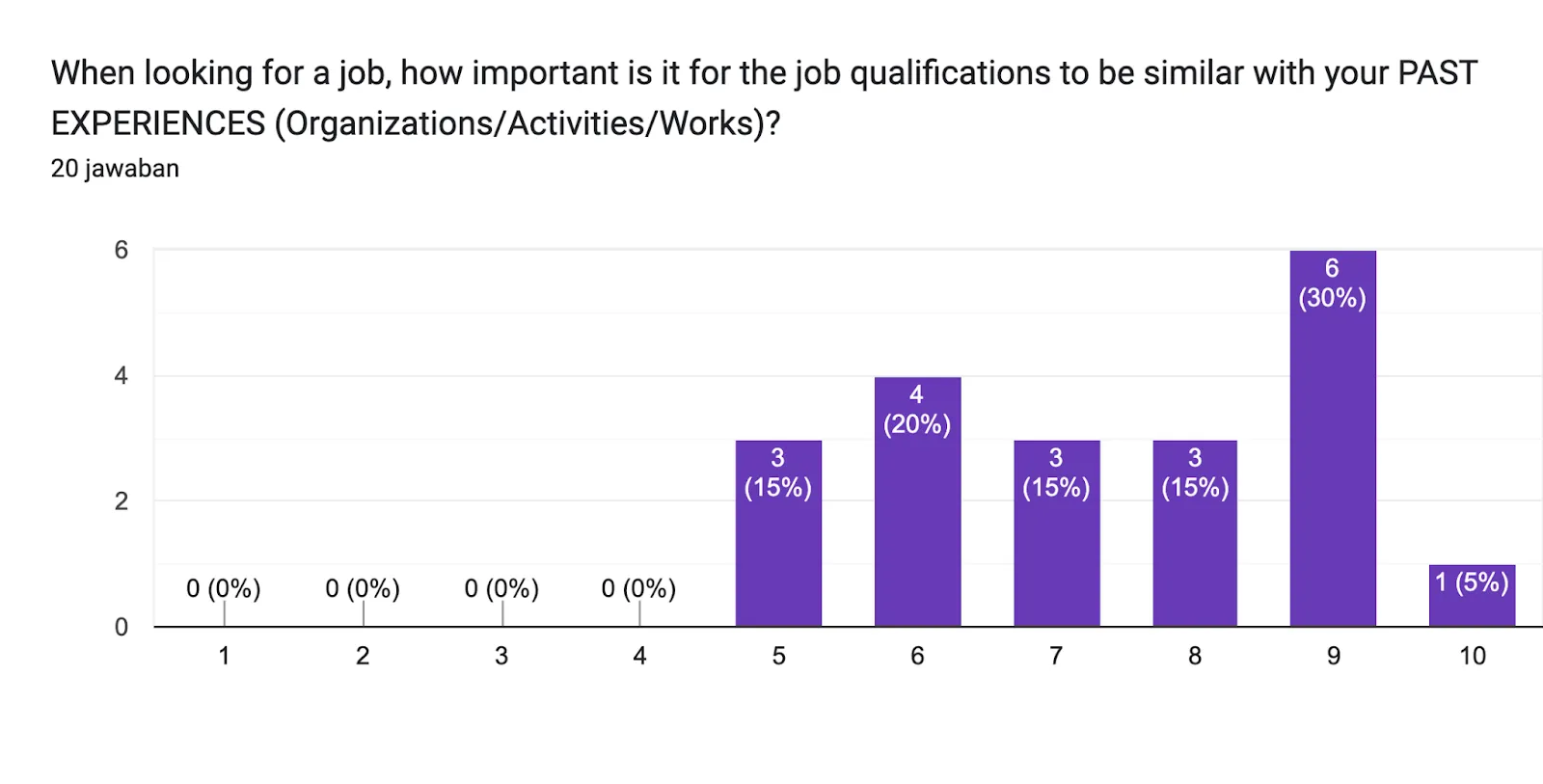
Image B.1. The importance of similarity with past experiences for 20 job-seekers (survey)
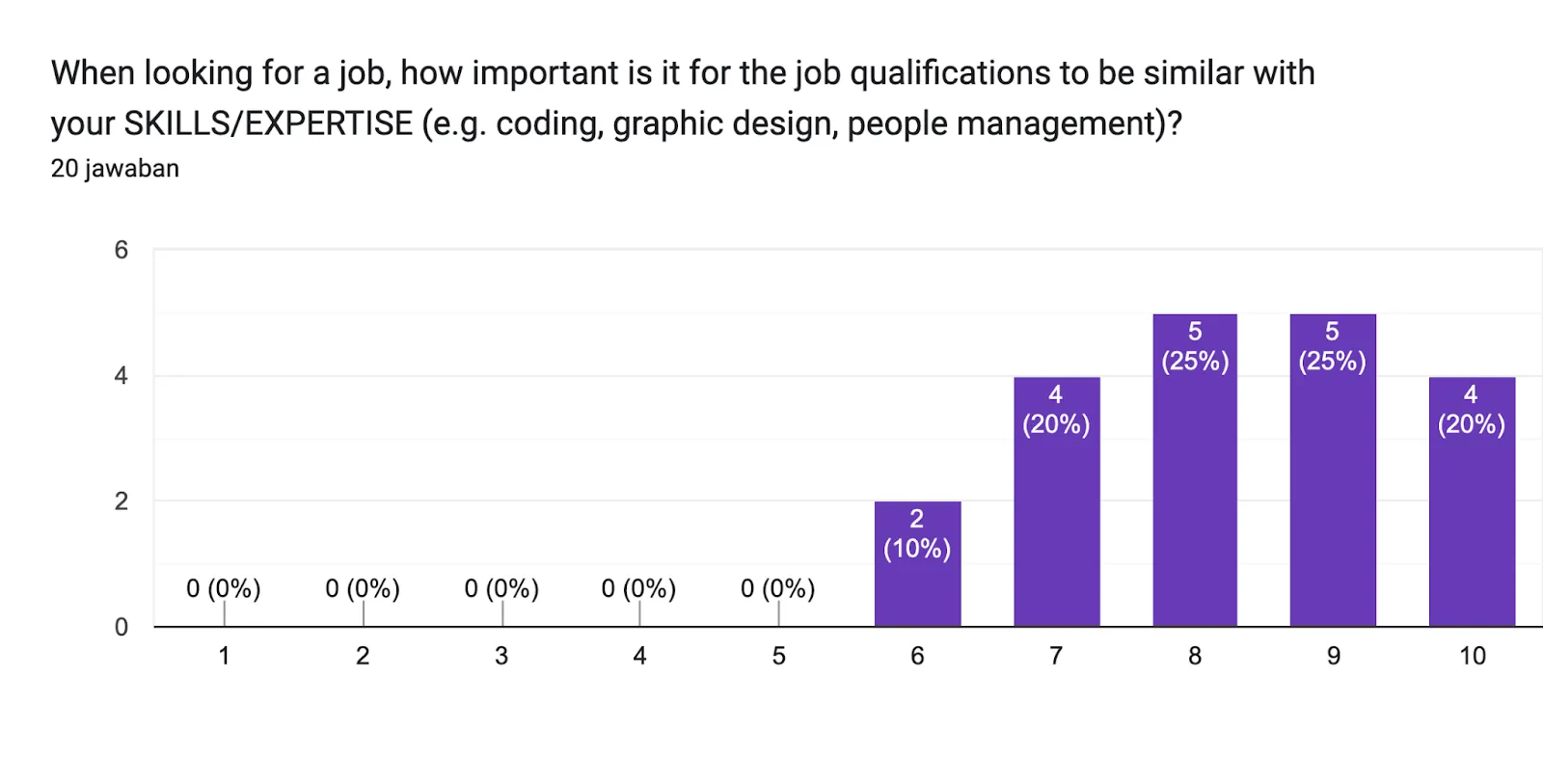
Image B.2. The importance of similarity with skills/expertise for 20 job-seekers (survey)
| Job Qualifications | Average |
|---|---|
| When looking for a job, how important is it for the job qualifications to be similar with your PAST EXPERIENCES (Organizations/Activities/Works)? | 7.40 |
| When looking for a job, how important is it for the job qualifications to be similar with your SKILLS/EXPERTISE (e.g. coding, graphic design, people management)? | 8.25 |
Image B.3. Importance average scoring of job qualifications between similarity with past experiences and similarity with skills/expertise (survey)
- Organized Job Prioritization: The current algorithm fails to deliver an order of importance in giving job recommendations for the user. There is a need to order the importance of job recommendation factors for users, and recommend them jobs accordingly. According to 20 job-seekers (image B.5.), they believe that jobs with similarity to their past experiences are the most interesting for them. The feelings of familiarity with their previous jobs prompt them to take on similar jobs in the future. Then, the second most important factor is similarity with skills/expertise since there will be more confidence in submitting a job application if the job-seekers’ skills/expertise aligned with the job expectation. And lastly, it is obvious that job recommendations need to be the same with the job titles that they preferred even though it is not as important as the other two factors.
- Steps to Implement:
- Train the algorithm model to have the highest accuracy in finding job roles with these criteria: similarity with past experiences in the user’s profile, similarity with skills/expertise in the user’s profile, similarity with preferred job title in the job preference settings.
- Develop a scoring system to rank jobs by relevance to the criteria.
- Develop a new function for the algorithm model to recommend jobs with similarity to past experiences first, then followed by similarity to skills/expertise, and their preferred job titles as the last priority.
- Develop a feedback mechanism which allows job-seekers to flag job recommendations as irrelevant directly in the interface. For example, include a “Not Relevant” button on each job recommendation
- Success Metrics:
- Low number of flagged irrelevant recommendations by the user
- Increased percentage of users applying for recommended jobs
- Collect feedback on recommendation accuracy through surveys
- Steps to Implement:
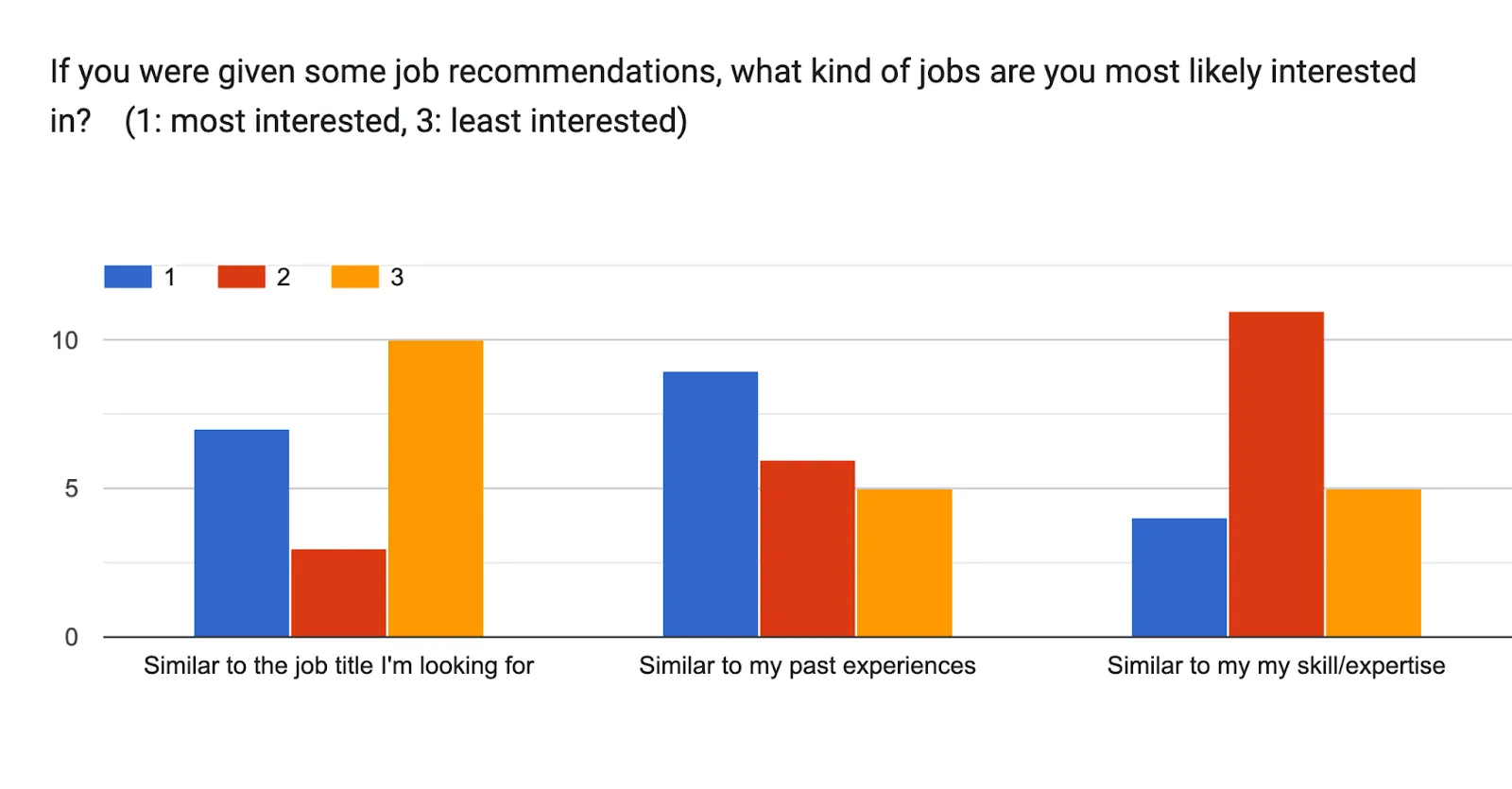
Image B.4. The importance of various job recommendation factors for 20 job-seekers (survey)
| No | Job Recommendations | Average |
|---|---|---|
| 1 | Similar to my past experiences | 1.80 |
| 2 | Similar to my skill/expertise | 2.05 |
| 3 | Similar to the job title I’m looking for | 2.15 |
Image B.5. Importance average scoring of job recommendations between similarity with past experiences, skills/expertise, and preferred job title (survey)
Besides these three improvements for the algorithm in the “Hanya Untuk Kamu” section, I would propose a new feature still related to job recommendations to further increase the number of applications per job-seeker. Job-seekers who use Dealls as their go-to job portal platform could only access the job recommendations when they open Dealls website or mobile application. There is an opportunity to give recommendations for job-seekers when they are not accessing Dealls platform through notification.
- Notification through in-app Notifications and Email Alerts for Recommended Jobs: With the new consistent and organized job recommendation algorithm, it would be a great opportunity to recommend the user directly through in-app notifications and email alerts. Notify users when new job postings align with their past experiences, skills/expertise, or preferred job titles. Push notifications or email alerts can keep users engaged and encourage higher application rates.
- Steps to Implement:
- Research further regarding the user’s behavior in receiving email recommendations to set the right frequency for notifying users and the right amount of job recommendations for the users.
- Store the user’s recent preferred roles into the user’s database.
- Add recommended jobs as an automated notification feature.
- Apply a weighted comparison to recommend jobs with the highest compatibility, may it be in terms of past experiences, skills/expertise, or preference.
- Success Metrics:
- Increased percentage of opened notifications
- Increased number of applications initiated through notifications
- Steps to Implement:
The above recommendations, based on observations of the Dealls platform, competitive analysis, and survey data from 20 job-seekers aged 20–29, aim to enhance the job recommendation system. There is still a need for validation regarding the effectiveness of these changes. We will need to conduct internal testing to measure the accuracy of the new recommendation system, and also A/B testing for both Dealls website and mobile application to measure users’ satisfaction using the new job recommendation algorithm.
C. Accessibility of Job Preference Settings
I can navigate and update my job preferences in the “Curated for You” section without difficulty. There are several reasons for this:
- Intuitive Interface: The current setup, with dropdown filters, is intuitive and functional, allowing users to adjust their preferences easily.
- Experience Level for Students: Experience level tailored for students, which can be seen from the 1st year to 4th year of college as one of the options. This is great in informing the job-seekers that college students can also apply for work, increasing their confidence.
- Salary Sorting: Having the highest salary as one of the sorting options is a great addition, catering to those who want to know the maximum salary they could receive with their current qualifications.
- Facility Preferences: The miscellaneous facility preference for the user, which is a competitive advantage that Dealls has, since not many other job portals provide an elaborate list of facilities for the job roles.
D. Accessibility Improvements for Job Preference Settings
While the current job preference settings are functional and have a lot of strengths, there is still some room for improvements that address overlooked user needs:
- Lack of Distance-based Filters
- Current Problem: Users must manually select multiple locations without the option to sort jobs by proximity, which is critical for those seeking on-site roles or jobs within a specific commute range. According to the 20 job-seekers survey, they prioritized proximity (4.55) above location (5.00) when looking for a job (image D.3.)
- Why this is important to fix: Users might miss job opportunities in locations they forgot to include in their preferred locations.
- Solution: Introduce a single input field for the user to choose a primary location, along with a range slider to calculate how far the user is willing to commute. This feature can enhance the relevance of job recommendations for users prioritizing convenience.
- Success metrics:
- Rising percentage of users who actively use the distance filter
- Increased clicks on jobs filtered by proximity
- Increased user satisfaction with location-based recommendations through surveys
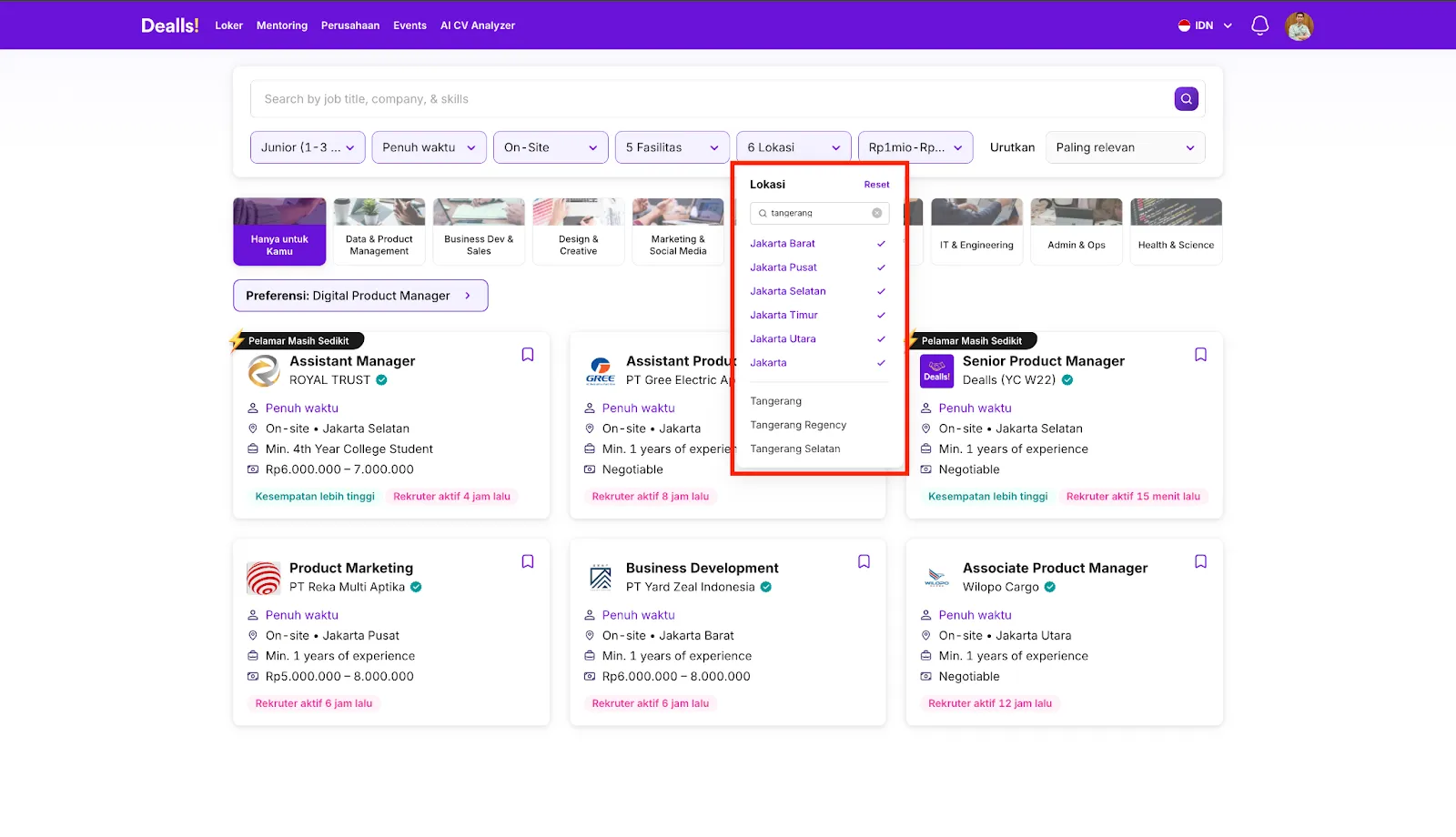
Image D.1. Location filter
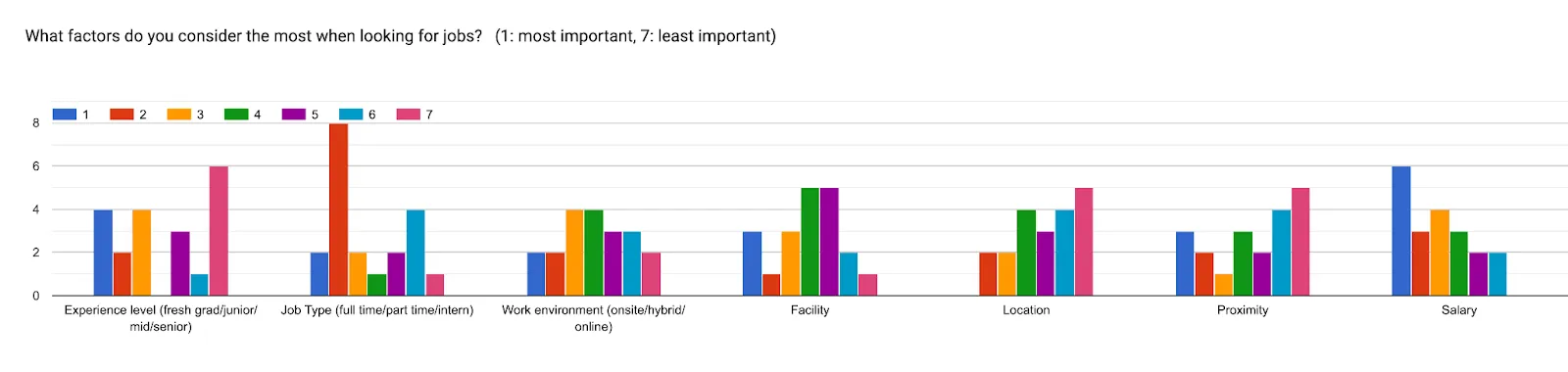
Image D.2. The importance of various job preference factors for 20 job-seekers (survey)
| No | Job Factors | Average |
|---|---|---|
| 1 | Salary | 2.90 |
| 2 | Job Type (full time/part time/intern) | 3.45 |
| 3 | Facility | 3.90 |
| 4 | Work environment (onsite/hybrid/online) | 4.05 |
| 5 | Experience level (fresh grad/junior/mid/senior) | 4.15 |
| 6 | Proximity | 4.55 |
| 7 | Location | 5.00 |
Image D.3. Job preference factors order of importance for 20 job-seekers (survey)
- Unreadable salary range
- Current Problem: The abbreviated display for salary range preferences is too narrow, showing only the first half of the salary range and cutting off the rest. This creates incomplete information, defeating the purpose of displaying a range.
- Why this is important to fix: Users need to see the entire salary range to fully understand the minimum and maximum salaries they set. The other reason is because salary range is the most important job preference factor for job seekers (image D.3.).
- Solution: Slightly widen the dropdown button to fit both the minimum and maximum salary values.
- Success metrics:
- Increased application rates for jobs filtered by salary range
- More positive feedback from users regarding the visibility of salary preferences
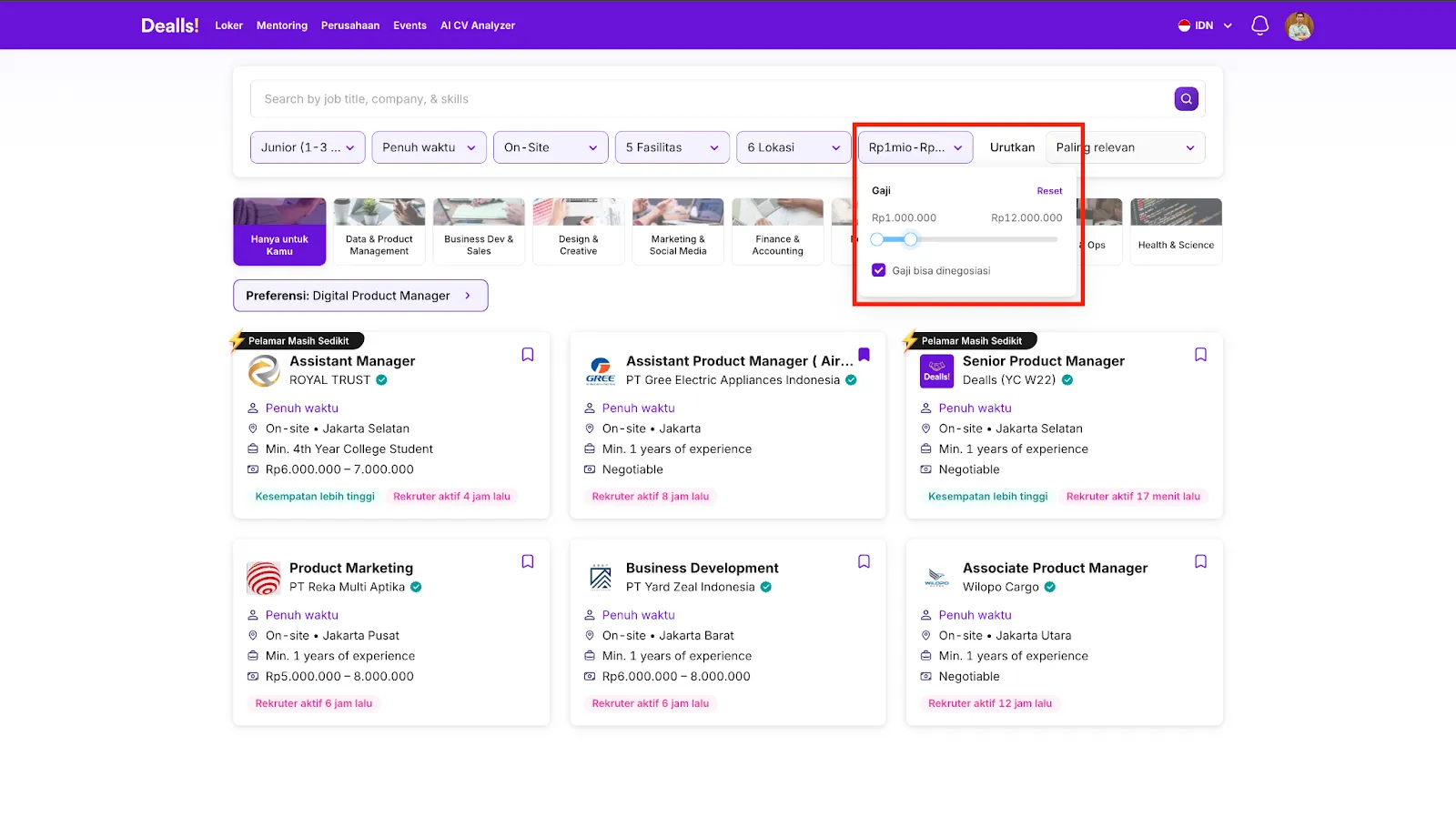
Image D.4. Salary range filter
- Incomplete Job Preference
- Current Problem: Each job category does not display all possible job titles in the list (Image D.5). Although the system contains data for all job types (Image D.6), these are not directly accessible to users.
- Why this is important to fix: Providing easy access to every job title ensures users are aware of all available options in job recommendations.
- Solution: Display every possible job title within each category. This will not decrease the user experience using the job preference settings, since the job title in each category is minimized unless the user clicks on it.
- Success metrics:
- Increase in the number of users who expand and modify job categories
- Reduction in the number of missed job opportunities who find roles outside their default preferences
- Improved satisfaction with job preference comprehensiveness
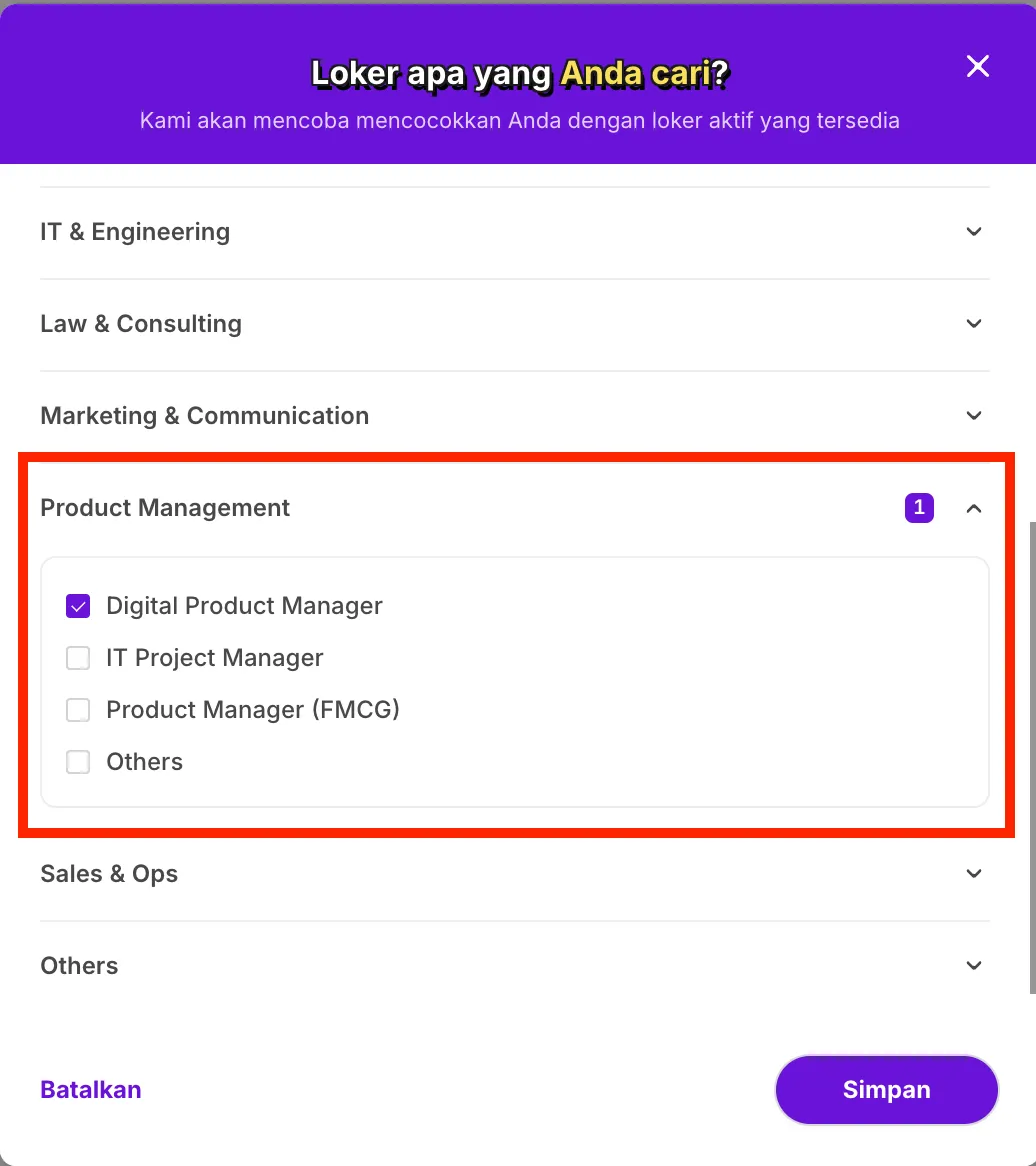
Image D.5. Job category in job preferences
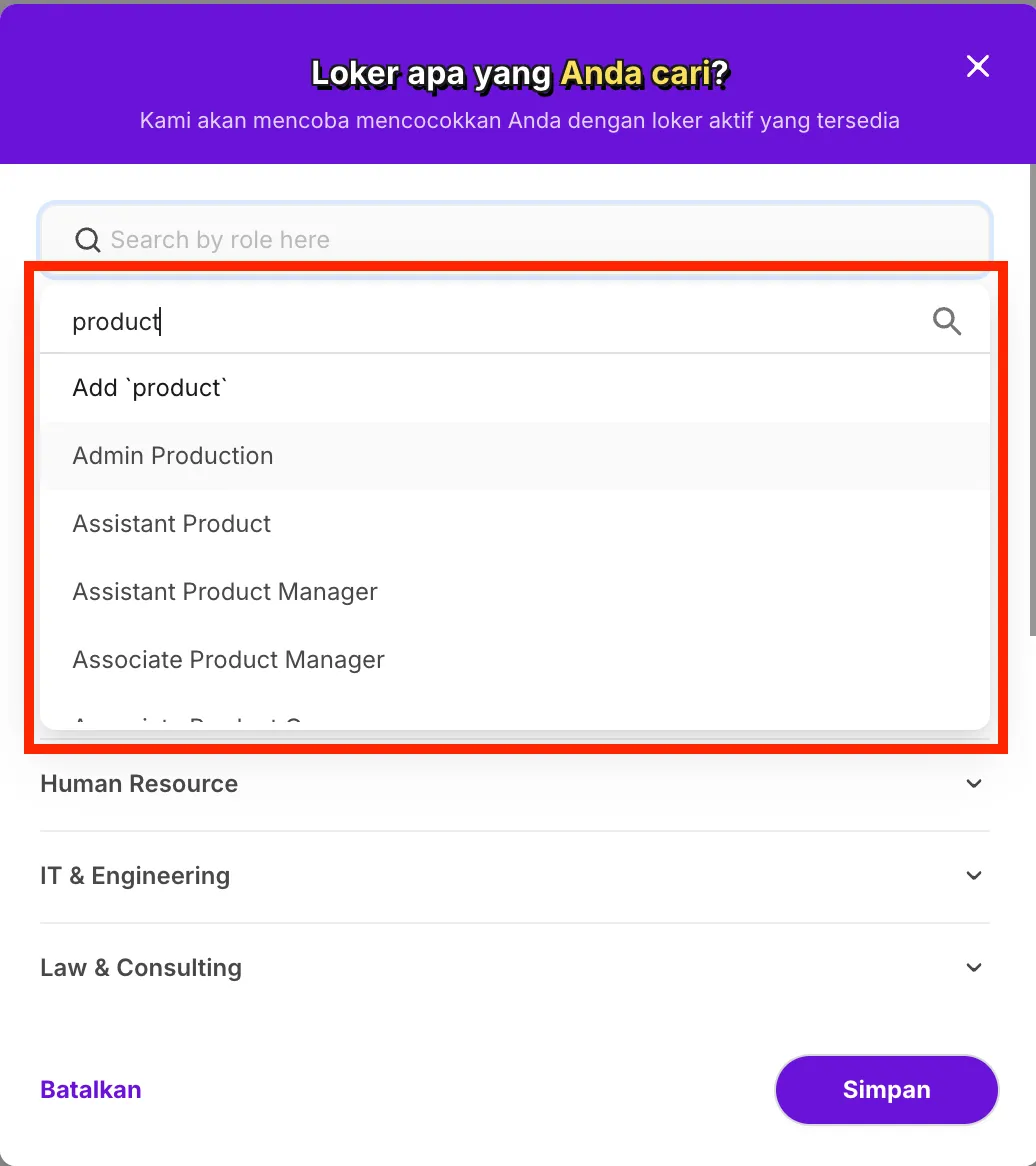
Image D.6. Autocomplete job preferences